 Aula· Spain, city by city
Andalucía
Granada
«Granada alberga el famoso palacio histórico de la Alhambra.»Granada is home to the famous historic Alhambra palace.
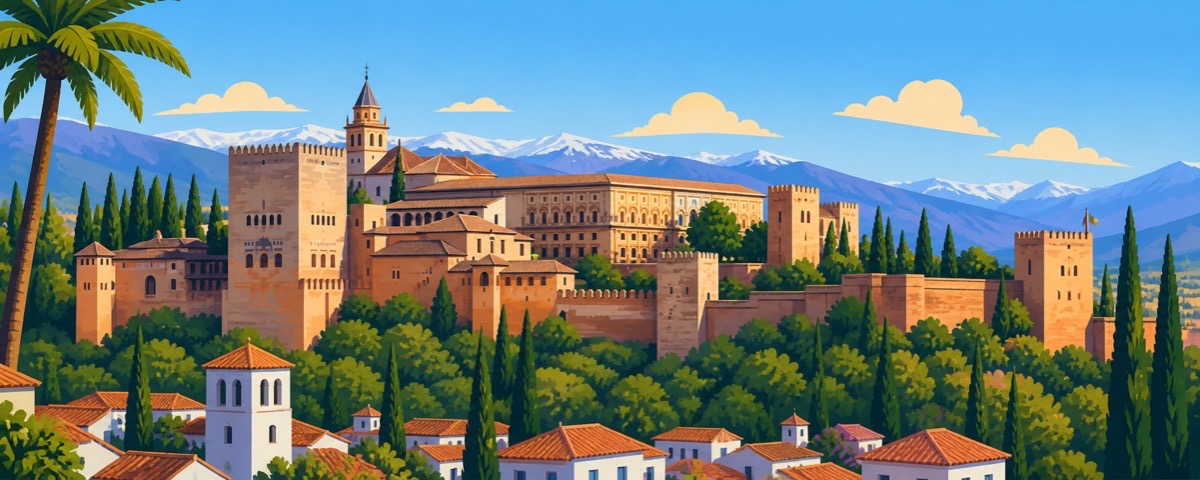
Granada lies at the foot of the Sierra Nevada, where the Vega plain meets the mountains, and was the last Muslim capital of the peninsula. On the hill in front of the centre are the Alhambra and the Generalife, while the Albaicín preserves the uphill streets of the Islamic quarter; the rest is a medium-sized university city.
Did you know
Here the tapas are free.
Granada is one of the few cities in Spain where a plate of tapas is still served for free with every single drink ordered.
How they talk in Granada
How people speak in Granada
The final «s» is aspirated and words are shortened. And here «tapa» doesn't mean a portion to order, but what comes with the drink: you can ask for it, but usually you can't choose it.
regomello
Remorse or inner restlessness. Colloquial use to indicate the weight or discomfort that remains inside after something.
Everyday life in Granada
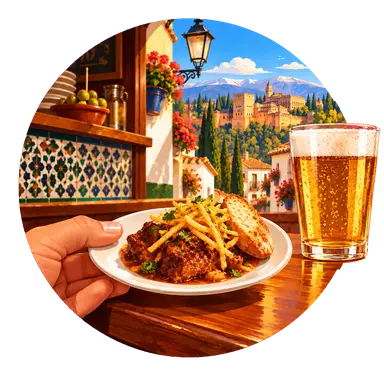
The «tapa» arrives on its own
You don't order it and you don't pay for it: you ask for a drink and something to eat arrives. It changes from bar to bar and with every round it becomes more substantial, so with three beers you've had dinner without having ordered anything.
«Otra caña, por favor.» — Another beer, please.
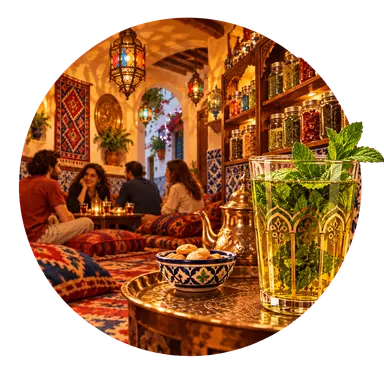
The teterías of the Calderería
In Calle Calderería Nueva you enter low rooms with cushions on the floor and tea in fifty varieties. It is a habit born in the nineties that has become part of the neighbourhood: you stay for hours, talk quietly, and no one comes to ask you for the table.
«Un té con hierbabuena, por favor.» — A tea with mint, please.
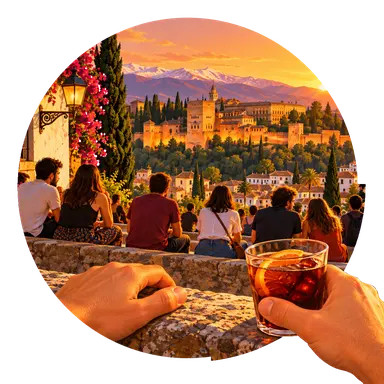
The wall of San Nicolás
An hour before sunset people go up to the mirador and sit on the ground on the wall waiting for the Alhambra to turn orange. The locals also go there, not just those passing through: it is an appointment, not a tourist stop.
«Subimos al mirador a ver la Alhambra.» — Let's go up to the viewpoint to see the Alhambra.
What to eat in Granada
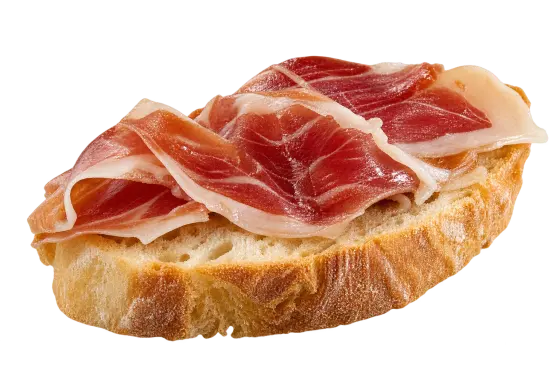
La tapa incluida
In Granada the «tapa» comes included in the price of the drink, and you don't choose it: the bar brings it. Every round brings a different one, and the more rounds you have, the more substantial it becomes.
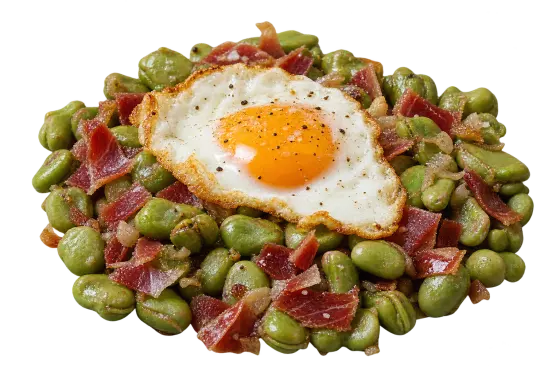
Habas con jamón
Fresh broad beans sautéed with Serrano ham and an egg on top. It is the dish of spring, when the beans are tender.
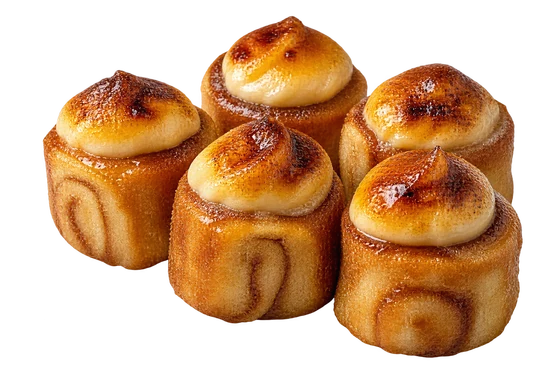
Piononos
Small sweet from Santa Fe: rolled and soaked sponge cake, with a little dome of toasted cream on top. It is eaten in two bites.
Festivals in Granada

Feria del Corpus
the week of Corpus Christi, between May and June
It opens with the Tarasca, the mannequin dressed in the fashion of the year that parades through the centre, and ends in a week of casetas.
What to see in Granada
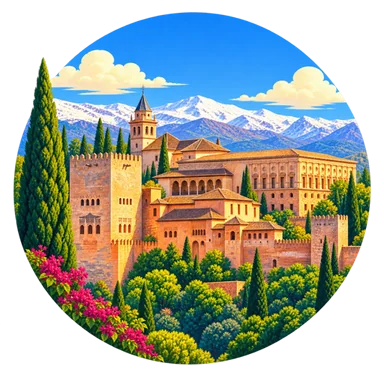
Alhambra
Nasrid citadel of the 13th-14th centuries: fortress, palaces and gardens together. In the Patio de los Leones, twelve marble lions support the fountain, and the walls are covered with stucco writing.
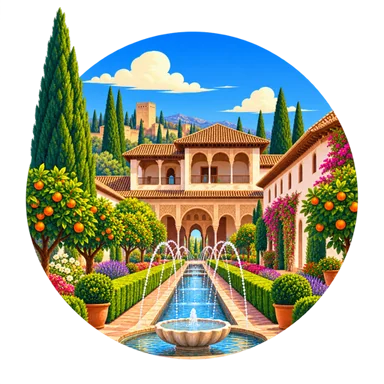
Generalife
The summer residence of the sultans, on the hill opposite the Alhambra: vegetable gardens, terraces and the Patio de la Acequia, a long canal with intersecting water jets.
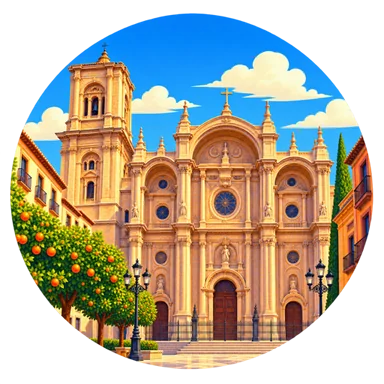
Cathedral
Renaissance, begun in 1523 over the main mosque. Next door, the Capilla Real houses the tombs of the Catholic Monarchs.
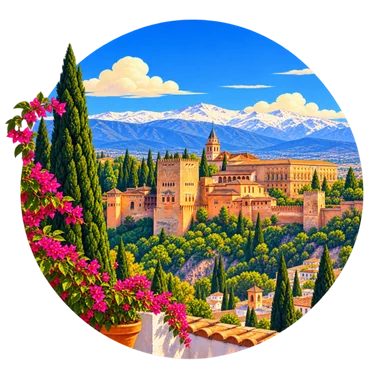
Mirador San Nicolás
In the Albaicín, the medieval Islamic neighbourhood: from there you can see the entire Alhambra with the snow-capped Sierra Nevada behind it. You can only get there by walking up.
Where Granada comes from
The last Muslim kingdom of Spain
7th century BC
Ilturir
Iberian settlement on the hill where the Albaicín stands today.
Roman era
Iliberri
Roman municipality, and later the seat of one of the first Christian councils of the peninsula.
1013–1238
Gharnata
Capital of a Zirid taifa kingdom: the neighbourhood on the hill dates from then.
1238–1492
Nasrid Granada
Last Muslim kingdom of the peninsula: the Alhambra and the Generalife are built.
1492 → today
Granada
The Catholic Monarchs enter the city: the cathedral and the Capilla Real arrive.
Born here: Federico García Lorca, poet.
Want to learn Spanish by travelling across Spain?
In Aula every lesson is a city lighting up on the map — Granada is one of them. Two hundred lessons from A1 to C2, free, starting from your level.
Start from Granada →