 Aula· Spain, city by city
Andalucía
Sevilla
«Sevilla tiene la catedral gótica más grande del mundo.»Seville has the largest Gothic cathedral in the world.
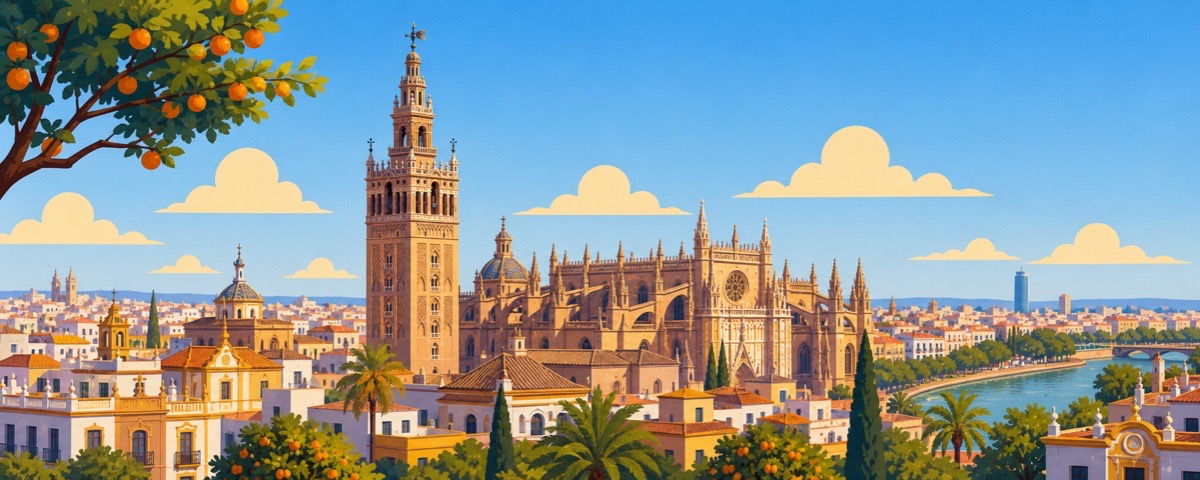
Seville is the capital of Andalusia and one of the great historic cities of southern Spain, built along the Guadalquivir. Its centre concentrates some of the most important monuments in the country — the Catedral with the Giralda, the Real Alcázar and the Archivo de Indias — while neighbourhoods like Triana and Santa Cruz preserve an urban fabric very different from the more modern part of the city.
Did you know
Christopher Columbus rests here now.
Inside the Seville Cathedral is the monumental tomb that holds the remains of Christopher Columbus.
How they talk in Sevilla
How it sounds
The «s» at the end of a word is not lost entirely: it becomes a breath. And the «d» between two vowels drops, so «pescado» becomes «pescao» — and that is why the dish is called «pescaíto».
Here they say: «¿Cómo ehtá?» — in standard Spanish «¿Cómo estás?»
«Mi arma»
Contraction of «mi alma», and it is used as we would use «dear» or «darling». It is not overly sweet: even the greengrocer and the taxi driver say it to anyone.
The «seseo»
Here «c», «z» and «s» all have the same sound, that of the «s». In textbook Spanish «casa» and «caza» are distinguished; in Seville they sound identical, and the context is what makes them understood.
Here they say: «la casa del sorro» — in standard Spanish «la caza del zorro»
Other expressions
«¿Qué pasa?» like «what's up?»; «tío» and «tía» to address someone without a name, like our «mate»; «no me digas» for «really?»; and «arre» like «come on, move it».
Everyday life in Sevilla
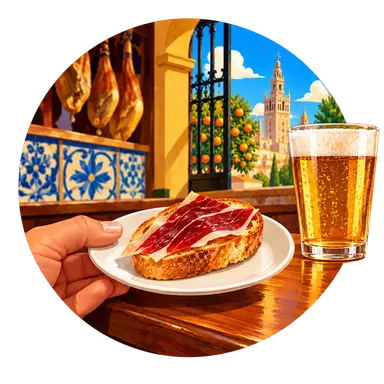
The «tapeo» is done walking
You don't sit down to eat tapas: you enter a bar, order one thing at the counter, drink standing up, pay and go to the next bar. A round can take in five places in two hours, and in each one you get what that bar does best.
«¿Nos vamos a la siguiente?» — Are we going to the next one?
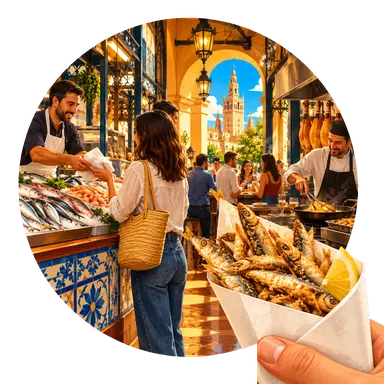
The Mercado de Feria
The oldest market in the city is half stalls and half bars: you buy the fish at the stall, take it two metres further on and they fry it for you while you wait. At midday the corridor is full of people standing with a paper cone in their hand.
«¿Me lo pueden freír?» — Can you fry it for me?
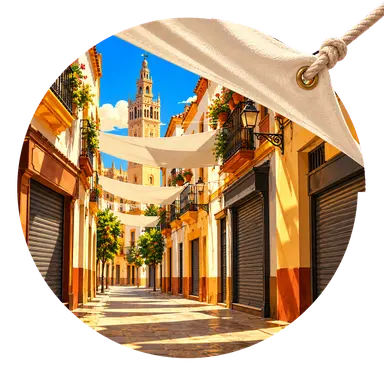
The «siesta» at half past two
From June to September, between two and six, the city really stops: the shutters go down and the streets empty. In the alleys of the centre, white sheets are pulled from one balcony to another, and you only go out again when the sun goes down.
«A esta hora está todo cerrado.» — Everything is closed at this time.
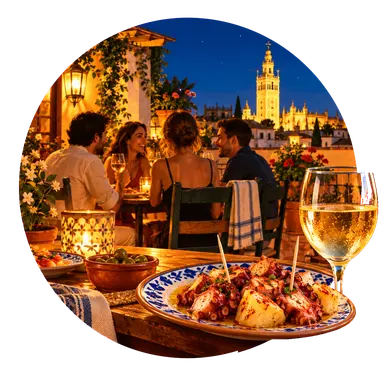
The evening that starts late
You have dinner at half past ten and get up after midnight. In summer the chairs come out into the street, and those who have a roof terrace use it: from the highest ones you can see the illuminated Giralda.
«¿Quedamos a las diez?» — Shall we meet at ten?
What to eat in Sevilla
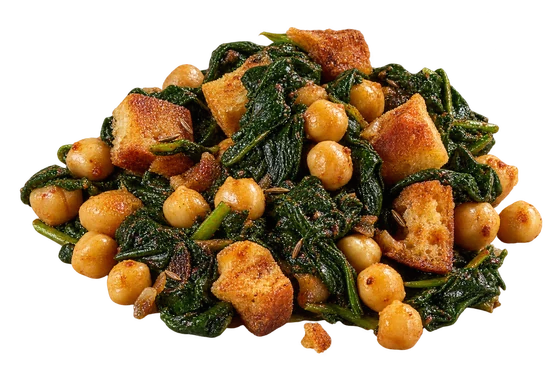
Espinacas con garbanzos
Spinach and chickpeas, seasoned with cumin, garlic and «pimentón». It is a simple dish but very rooted in Sevillian cuisine, and is eaten with bread.
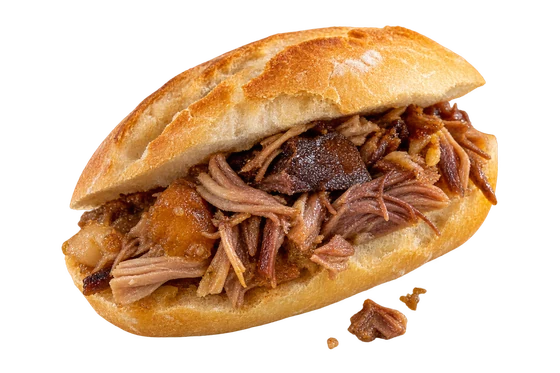
Montadito de pringá
The «pringá» is born from the meats of the «puchero»: pork, chorizo, «morcilla» and other cuts are shredded and put inside a small warm bread.
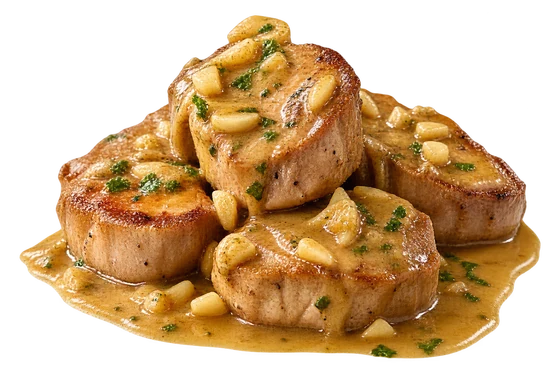
Solomillo al whisky
Sliced pork tenderloin in a sauce of garlic, lemon and whisky, served with fried potatoes.
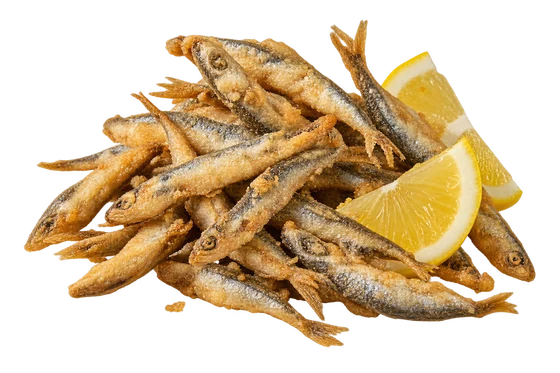
Pescaíto frito
Small fish floured and fried in olive oil, crispy and served freshly made.
Festivals in Sevilla
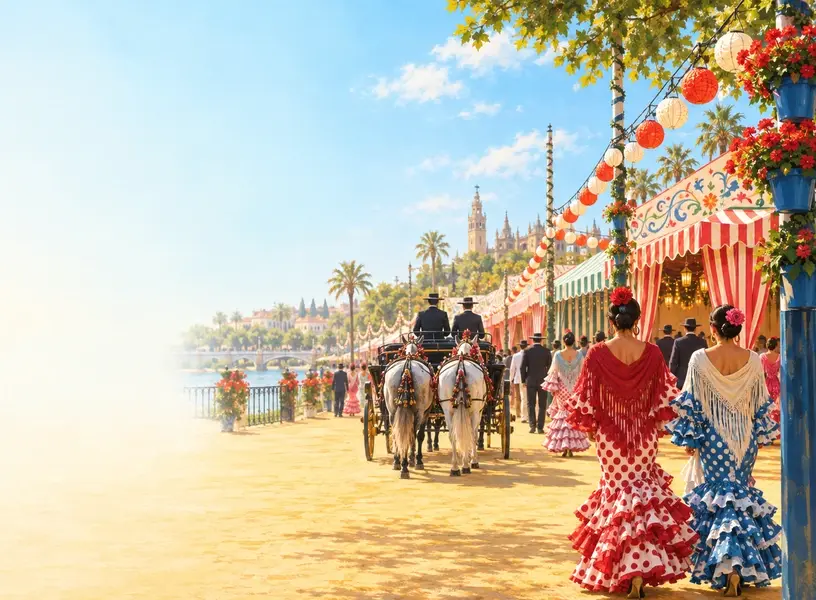
Feria de Abril
two weeks after Holy Week
A week of «casetas», horses and sevillanas in the Real de la Feria, in Los Remedios.
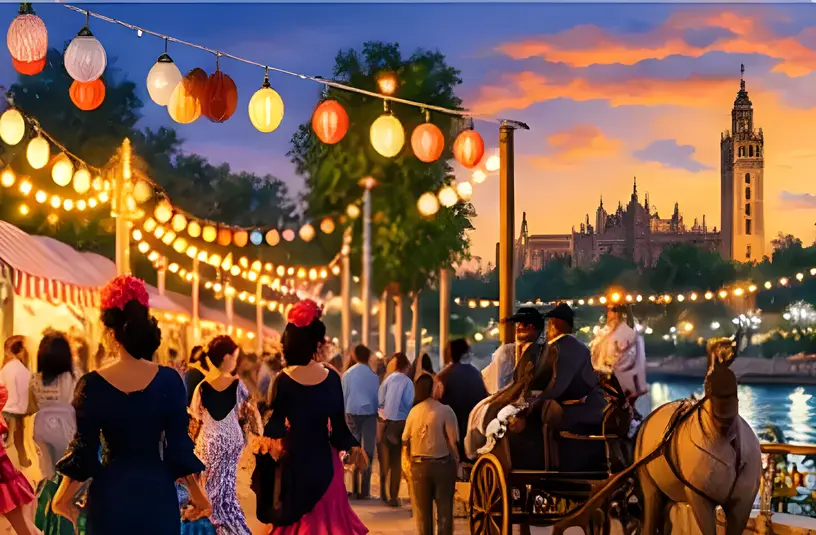
Velá de Santa Ana
from 21 to 26 July
Six days of celebration in Triana, along Calle Betis, with the «cucaña» on the Guadalquivir.
What to see in Sevilla
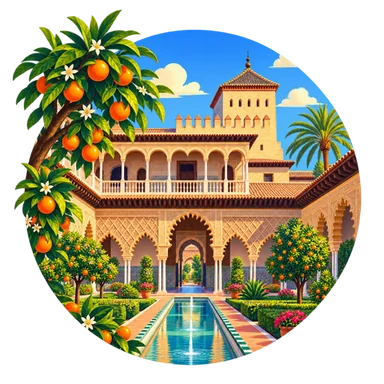
Real Alcázar
Complex of medieval palaces still used as the official residence of the Spanish royals when they are in Sevilla. In the halls, Islamic, «mudéjar», Gothic, Renaissance and Baroque forms coexist, and the gardens with fountains and orange trees are among the most beautiful in Spain.
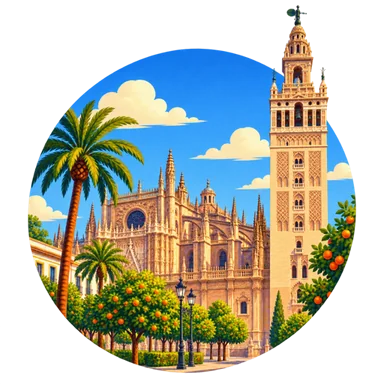
Cathedral
The largest Gothic cathedral in the world, built between the 15th and 16th centuries. The Giralda next to it was the minaret of the 12th-century Almohad mosque: its 104 metres and 24 bells can be read immediately from the square.
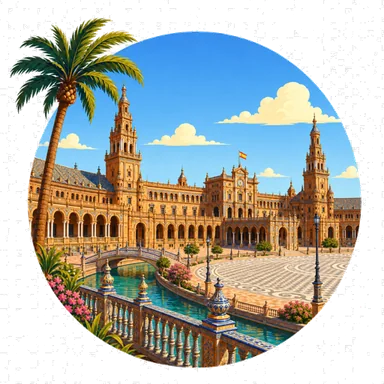
Plaza de España
Built in 1929 for the Ibero-American Exposition: a semicircle of brick and ceramic with a canal, bridges and an «azulejos» bench for each of the Spanish provinces.
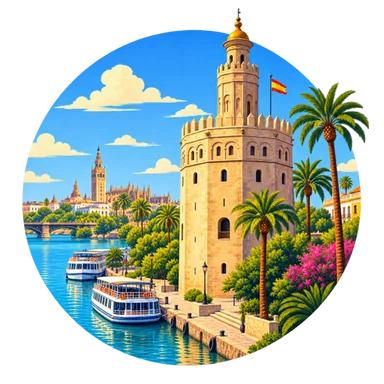
Torre del Oro
13th-century watchtower raised by the Almohads on the Guadalquivir. Today it houses a maritime museum that tells of the voyages to the Americas, which departed from this very bank.
Where Sevilla comes from
A city over 2,800 years old
8th century BC
Ispal
First settlements linked to the Tartessian world, where the Guadalquivir was still navigable up to here.
Roman era
Hispalis
Large river port; eight kilometres away Itálica is born, the city of the emperors Trajan and Hadrian.
8th–13th century
Isbiliya
Capital of a taifa kingdom and then of the Almohads, who raise the Giralda and the walls.
1248 → 16th century
Sevilla
Fernando III conquers it; from 1503 the Casa de Contratación gives it the monopoly on trade with the Americas.
Born here: Diego Velázquez, painter.
Want to learn Spanish by travelling across Spain?
In Aula every lesson is a city lighting up on the map — Sevilla is one of them. Two hundred lessons from A1 to C2, free, starting from your level.
Start from Sevilla →